



If you’re struggling with overthinking, understanding how to make decisions based on your Human Design has the potential to completely change your life. Let me give you an example:
If you had told me a few months ago that I’d be leaving Manhattan Beach — our little cottage, the ocean, and the relaxed beachy vibe — and moving to Northeast LA, I would have said, “No chance – if I’m moving anywhere, it’s out of the country.”
And yet, here I am — a full month into our new place, still pinching myself at how good it feels and how perfect our new home is. We’re walking distance to so many things, we have this renewed sense of energy and joy, and we’re so much closer to friends and family. Overall, it’s been a beautiful reminder that our mind has no idea what will actually make us happy.
Which brings me to today’s topic: how to make the right decisions for your life. This might be the most important thing you ever learn how to do, because your decisions create your life. The experience you’re having right now is connected to decisions you made months, years, even decades ago.
Want to watch + listen instead? Check out the YouTube video on this topic:
If you haven’t listened to Episode 26: The Success Mechanics of Your Type, start there first. And if you’re new to Human Design, you can download your free advanced chart here.
Why Our Mind Makes Bad Decisions
The problem is, most of us were conditioned from birth to make decisions using our mind. We try to be logical, sound, and reasonable, but psychology has shown that our mind prioritizes safety above anything else. We tend to choose the undesired known over the desired unknown because it feels safer.
If you have a history of financial scarcity, for example, it’s easy to find yourself in a pattern where you’re never earning more than the bare minimum. Or when you do make more money, it disappears instantly. Raising your prices can feel triggering — even if you logically know that the higher price is completely fair — because your mind isn’t prioritizing growth and expansion. It simply wants to keep you safe.
This is where Human Design serves us so beautifully, because it gives us tools to navigate life and make decisions without so much mental rumination. Our mind isn’t our enemy, it’s just not designed to be our final decision-maker.
Understanding Strategy & Authority Without Overthinking
Strategy and Authority are talked about a lot in Human Design, but they’re often engaged with in a really mental way, which kind of defeats the purpose.
A Projector might start waiting for an invitation to do literally anything, like attending a concert, launching their podcast, or chatting someone up at a bar. A Generator might sit on the couch waiting for a sacral response, looking for those “uh-huh” and “uh-uh” sacral sounds (which I’ve never found to be accurate).
And then nothing happens. You’re stuck, you’re out of the flow, and life starts passing you by. You can end up even more frustrated and dissatisfied because you’re approaching a body-based system in a top-down way.
Tbh, I think you’d have better results by just taking messy action and observing over time whether it feels aligned, rather than sitting around waiting for something to happen to you.
How to Use Your Human Design Authority in Real Life
So, here’s the first thing you should know: your mind is an interpreter and a processor. While it’s not your decision-maker, for most people, it will play a role in your decision-making process.
If you have Sacral Authority or Splenic Authority, you have reliable physical cues that indicate whether a decision is correct for you. With awareness and practice, you can tune into your body in the moment and know a reliable truth about what to do.
But if you have any of the other authorities – Emotional, Ego, Self-Projected, Lunar, or Mental – you don’t have that reliable physical sensation. Your mind is going to be involved in the process because you’re paying attention to your experiences and results over time.
As an Emotional Generator, I have a Sacral response (and a defined Spleen that does contribute to my moment-to-moment, instinctive decision-making), but when it comes to big life decisions, I need to wait for Emotional clarity.
And one thing that’s really important to know about emotional clarity is that it never feels 100% certain. Anytime I feel complete certainty about a decision, it’s usually coming from my mind, because the mind is what seeks certainty.
Real-Life Example: An Emotional Generator’s Process
For example: I had known I wanted to move for a while, but my mind assumed it would be out of the country. The emotional wave process had kicked off over a year before, and I was just processing it over time and seeing what happened — traveling to different places, noticing how I felt, and tuning into the energy in each environment.
There were a few places I thought I would want to move to, but they just didn’t connect. And this is where the “waiting” part of Human Design comes into play – sometimes we wait an annoyingly long time for the answer or result, but ideally, we’re still in the flow and living our life without getting too caught up in what we think should be happening.
So then, back in November, my girlfriend was visiting a friend who had just moved to this neighborhood in Northeast LA. She jokingly texted me: “A spot is opening up in their building, they said we should move in.”
And I was like, wait – should we? So I started making a pro/con list – this is an example of what I mean by the mind being involved in the process – and I just knew. I texted her: “Uh-oh,” and the rest was history:
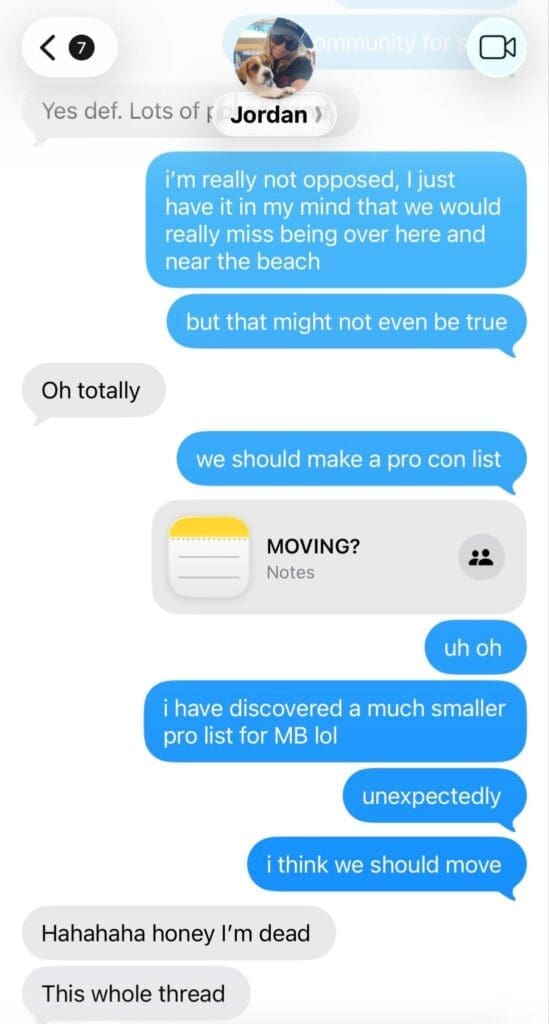
Ultimately, it wasn’t about the list. It was recognizing that physical sense of peace, clarity, and connection, which I’m now very familiar with as an Emotional Generator. Then a week later, that same friend shared an Instagram story from someone who was looking for a renter.
We came to see the place, and it was an exact match of what I had visualized and written in my journal: a beautiful, sun-drenched home in a calm but vibrant neighborhood, walking distance to shops and restaurants, and surrounded by nature.
It might take awhile, but when you know, you know.
Use Human Design Strategy for Big Decisions
The second thing to know is that your Strategy – learn your Strategy as a Manifestor, Projector, Generator, Mani Gen, or Reflector here – is most relevant for bigger life decisions, particularly ones that involve other people: a new job offer, a new home, and a new relationship or partnership of some kind.
I don’t wait for a sacral response or tune into my solar plexus to decide what to make for lunch, whether to go for a walk, what content to create, and so on – I simply go about my day and make adjustments based on where my energy feels most engaged.
And if I notice that I’m consistently dragging my feet on certain things, that will inform bigger decisions over time (like deciding to retire an offer that’s no longer aligned, or taking a step back in a relationship).
For the smaller day-to-day decisions, your Cognition actually plays a bigger role. I have Inner Vision cognition, which means visualization and reflection are a big part of my process. If I can’t see something playing out in my mind’s eye, that tells me something. And if you’ve ever been on a call with me, you know I spend most of the time gazing away from the screen as I speak.
While it may not seem classically “professional,” tuning out external stimuli is how I tune in. I often hear that my readings are unlike anything people have experienced before, and that the way I translate Human Design is very different. The best way I can describe the process is that it feels like I’m translating a frequency more so than information, and briefly closing my eyes or looking off-screen is the only way I can access it.
As a business owner, creating space for my Cognition has been huge. If I’m creating a new offer or planning content, I’ll spend a few moments visualizing it or doing a full bathtub meditation (I am a Pisces, after all). And when I’m in the visioning and building phase, I often wake up with something playing out in my mind – not exactly a detailed answer, but a clear sense of the right way.
This is one of the reasons I love covering Variable in readings and think it’s especially important for business owners.
Moving Beyond the Human Design Chart: Somatic Healing
The last thing you should know is that what often keeps us stuck repeating not-self patterns– and struggling to get anything out of systems like Human Design – is the conditioning that lives in our body, making it difficult to make different choices. And making different choices is the only way to real transformation.I’ve met people who know every detail of their Human Design chart but haven’t experienced any real shift. That magnetism you feel when someone is truly living as themselves just isn’t there. Usually, it’s because they’re thinking their way through rather than being in the process.
As someone who experienced complex PTSD for most of my life, discerning my trauma response from my sacral response and emotional authority was an essential part of this process.
I lived in a state of emotional chaos for many years, and it took a long time to learn that those emotional spikes and crashes were not connected to my emotional authority at all – they were rooted in mental perception, which was created by decades-old trauma.
Our perception influences our feelings and reinforces deeply held beliefs, even if they don’t align with our truth and our desired experience in life. I spent years trying to think my way through trauma: “If I could just figure out exactly what happened, I could solve it.” And it never worked.
What did create transformation were somatic practices and healing experiences – like somatic therapy, equine therapy, and, honestly, dancing all night in clubs with friends, feeling connected and safe and witnessed for the first time (and while I am NOT recommended drugs, they did play a big part in this process of feeling safe in community, which I shared about in this episode on my journey with fawning).
This foundation of internal safety is what enabled me to make different choices, to see things from a new perspective, and fully land in the belief that I was worthy of love, success, and all the other things we desire in life.
So if you haven’t noticed any real transformation from Human Design or using Strategy & Authority, consider the role conditioning might be playing in this process – where is your unconscious trying to keep you safe but stuck despite how much you consciously desire change?
Key Takeaways: Building Trust in Your Authority
I recently asked on Instagram whether people had questions about their authority, and no matter the type, every question came down to the same thing: “How do I trust it? How do I know I’m making the right decision?”
1 Action precedes clarity.
The answer is always action – making decisions without getting stuck in mental rumination. The best thing I did in my 2nd year of experimenting with Human Design was disregarding the “wait for a sacral response and emotional clarity” advice I kept being given, and simply engaging with it in low-stakes situations (like deciding whether or not to go to a party).
2. Observe and reflect over time.
Just because a situation wasn’t happy or positive doesn’t mean it was the wrong decision, and just because something felt fun doesn’t mean it was “right.” Which decisions lead to more of your signature? Which gave you the experience you needed? Oftentimes, it’s uncomfortable situations where we practice staying in the discomfort that serves us the most (and this is why somatic work is so important). Only you can know, and it takes time.
3. Practice discernment.
If you have Sacral authority and ADHD, discerning between a dopamine hit and a true sacral response is crucial (if it feels like a high, it probably is – real satisfaction has substance). If you have Self-Projected authority, listen for the resonance of your truth when you speak — that voice is coming from your G Center, not your mind. If you have Emotional authority, remember that 100% certainty is usually coming from the mind.
4. Build your self-trust muscle.
Over time, you may find there is less mental processing around your decisions. These days, I either know that I don’t know yet, or I know that something is right for me or not and I just move forward. It’s taken years of practice and integration, but it feels natural and intuitive, and this translates to faster and more effective decision making, despite having the “slowest” authority in Human Design.
And I can’t begin to tell you how much energy is returned to you when you’re no longer stuck in the past questioning your decisions – you will find yourself staying in the present moment so much longer, less prone to distraction and mental fatigue. It’s true liberation.
Go Deeper with Your DesignIf you’re ready to go deeper with your Design and synthesize your chart – from the natural gifts of your Channels to decision making with your Cognition — my Legacy Human Design Reading is the place to ask your burning questions and refine your approach to life, relationships, and career. Learn more and book your reading here.